

Best Evidence for Injury Claims That Wins
Right after a crash or serious fall, most people are not thinking about evidence. They are thinking about pain, missed work, a wrecked vehicle, and an insurance company already asking questions. But the best evidence for injury claims is often gathered in the first hours and days, and those early details can shape what your case is worth later.
Not all proof carries the same weight. A clear photo of the scene may help, but medical records that tie your injury directly to the incident often matter more. A witness statement can support your story, but phone calls with the insurer can still be used to minimize your claim if you are not careful. Strong cases are usually built with layers of evidence that work together, not one dramatic piece of proof.
What counts as the best evidence for injury claims?
The best evidence for injury claims is evidence that answers three basic questions: who caused the incident, how badly you were hurt, and how those injuries affected your life and finances. If your proof does not help establish one of those points, it may still be useful, but it probably will not drive the value of the case.
Liability evidence shows fault. Damage evidence shows the physical, financial, and personal consequences. The most persuasive claims connect both sides cleanly. It is not enough to show that an accident happened. You also need to show that the accident caused your injuries and losses.
That is where many people run into trouble. Insurance companies look for gaps. If there is a delay in treatment, inconsistent statements, missing photos, or no documentation of missed income, they may argue that the injury is not as serious as claimed or was caused by something else.
Medical records usually carry the most weight
In most injury cases, medical records are the foundation. They document what injuries you suffered, when symptoms began, what treatment was required, and whether you are expected to recover fully. They can also show pain levels, physical limitations, and whether your condition worsened over time.
Timing matters here. If you wait too long to get evaluated after an accident, the other side may argue that your injuries were unrelated or not serious. That does not mean every delay ruins a claim. Some injuries take time to become obvious. But from a legal standpoint, prompt care creates a clearer record.
Consistency matters too. If one record says you hit your head and another says you did not, the insurer may treat that inconsistency as a reason to question everything else. That is one reason it helps to be accurate and thorough when describing what happened and how you feel.
Photos and video can be powerful, but context matters
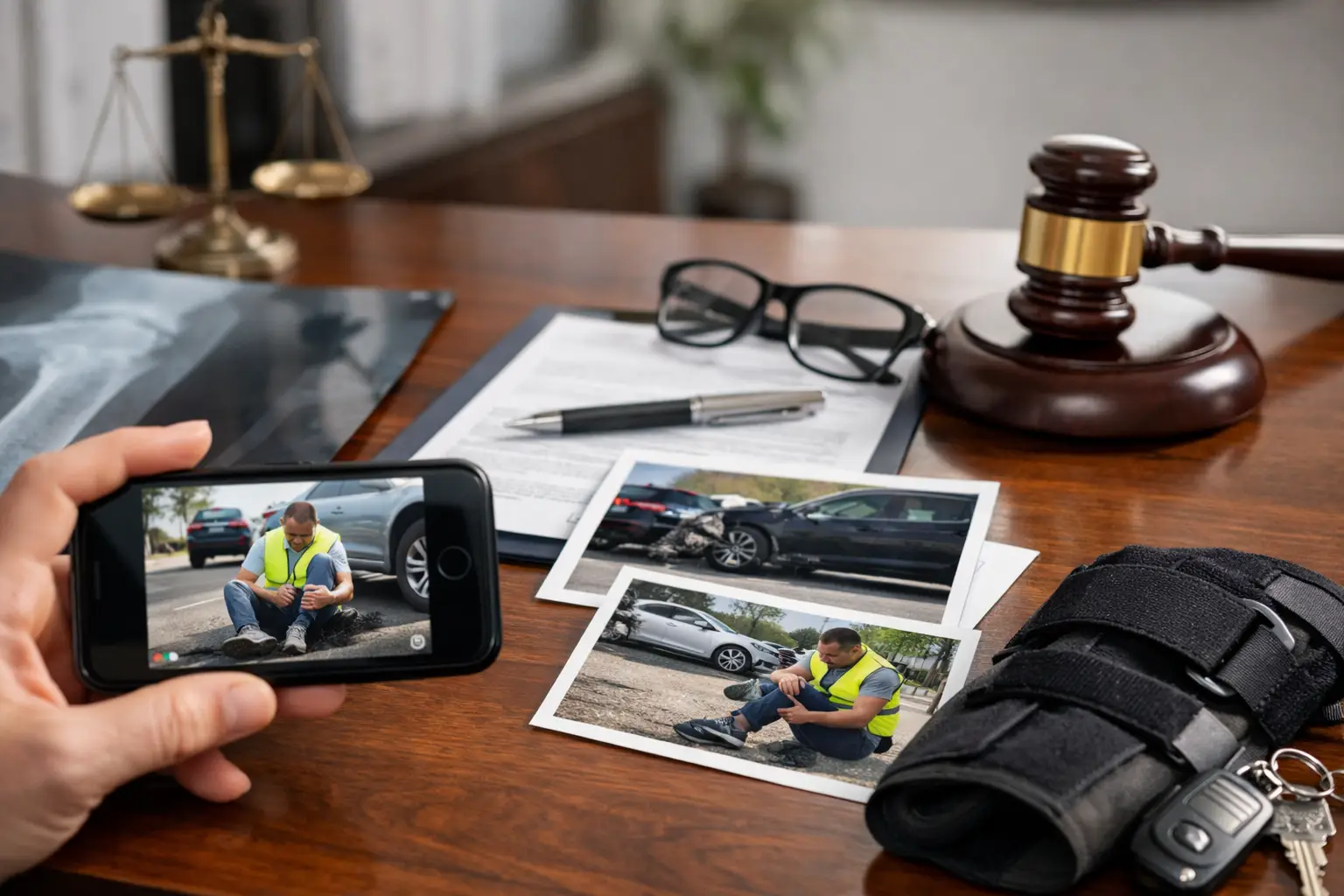
Photos of the accident scene, vehicle damage, visible injuries, road conditions, debris, lighting, and hazards can make a major difference. Video footage can be even stronger because it may show how the incident happened in real time.
Still, visual proof has limits. Property damage does not always reflect injury severity. Some people suffer major physical harm in crashes that leave less visible damage than expected. On the other hand, dramatic photos alone do not prove the full extent of pain, disability, or future medical needs.
The strongest use of photos and video is to support the broader story. They help show force, positioning, dangerous conditions, and visible trauma. When combined with treatment records and witness accounts, they become much harder to dismiss.
Witness statements can fill in the gaps
Independent witnesses can be valuable because they are less likely to be seen as biased. If someone saw a driver run a red light, a truck drift into another lane, or a property hazard that had been left unaddressed, that testimony can support your version of events.
Witnesses are not perfect. Memories fade fast, and details get mixed up. That is why early statements tend to be more useful than ones gathered much later. Contact information matters as much as the statement itself. If nobody can locate the witness later, that evidence may be harder to use effectively.
There is also a difference between a witness who saw the incident and a family member who only saw the aftermath. Both can have value, but they serve different purposes. One helps prove fault. The other may help explain pain, limitations, and changes in your daily life.
Official reports help anchor the claim
When officers respond to a collision or a business documents an incident on its property, those reports can provide a helpful starting point. They often include the date, time, location, involved parties, visible conditions, and initial observations.
These records are important, but they are not always the final word. Reports can contain errors, omit key details, or rely on incomplete information. If a report is favorable, that helps. If it is not, your case may still be strong if the rest of the evidence tells a clearer story.
That is why injury claims should never rest on one document alone. A report is one piece of the case, not the whole case.
Lost income and out-of-pocket losses need paper proof
A lot of injured people focus on proving they were hurt but do not gather enough evidence of what the injury cost them financially. That can leave real money on the table. If you missed work, lost earning capacity, paid for prescriptions, needed transportation help, or had other accident-related expenses, you need documentation.
Pay records, tax records, employer confirmation, receipts, invoices, and account statements can all help show economic losses. The clearer the paper trail, the harder it is for the insurance company to downplay those damages.
This is especially important when the injury affects your ability to return to the same kind of work. A claim involving ongoing limitations often requires more than a simple note that you missed a few days. It needs a broader picture of how the injury changed your earning ability.
Your own records can strengthen the human side of the case
Some losses do not show up neatly on a bill. Pain, sleep problems, missed family activities, emotional strain, and day-to-day physical limits are real damages, but they are often harder to prove.
That is where personal documentation can help. Notes about symptoms, mobility problems, disrupted routines, and the ways the injury affects home and work life can support the claim. Family observations may help as well, especially when they describe specific changes rather than vague statements.
There is a balance here. Personal records are useful, but they are strongest when they match the medical record instead of contradicting it. Accuracy matters more than drama.
What can hurt your evidence
Strong claims are not just about what you collect. They are also about what you avoid. Social media posts are a common problem. A photo taken on a relatively good day can be used to suggest that you are not really injured. Casual comments to insurers can also be twisted into admissions that minimize fault or pain.
Delays, gaps, and inconsistency can all weaken a case. So can lost evidence. If a damaged vehicle is repaired too quickly, surveillance footage is overwritten, or a hazardous condition is cleaned up before it is documented, important proof may disappear.
That does not mean the case is over. It means the remaining evidence has to work harder.
How a lawyer helps secure the best evidence for injury claims
The best evidence for injury claims is not always sitting in your phone camera roll. Sometimes it has to be preserved, requested, organized, and connected in a way that makes the full case clear. That is where legal representation matters.
A lawyer can move quickly to identify what evidence exists, what may disappear, and what needs to be obtained from third parties. That may include scene evidence, business records, vehicle data, witness follow-up, and documentation tying your injuries to your losses. Just as important, your attorney can present that evidence in a way that pushes back when the insurer tries to distort the facts.
For injured people in North Texas, this part of the process matters more than most realize. You may know what happened. You may know how badly your life has been disrupted. But knowing it and proving it are not the same thing.
If you are dealing with a serious injury claim, think less about one perfect piece of proof and more about building a complete record. The strongest cases show fault, injury, and impact from multiple angles. When the evidence is gathered early and handled carefully, it does more than support a claim. It protects your voice at a time when others may be trying to talk over it.


About Post Author
